
Database mining is working your existing CRM and DMS records for customers who are ready to transact now, rather than buying new leads. Build five lists — positive equity, service-drive owners, lease maturities, unsold showroom traffic and unsold internet leads — clean them before you call, and write different outreach for each. It is the cheapest traffic a dealership owns, and in most stores it is worked by nobody in particular.
Why the Database Is the Cheapest Traffic You Own
Ask a general manager where next month's units are coming from and you will hear about lead providers, ad spend and floor traffic. Ask how many customers in the CRM are currently in a positive equity position and the answer is usually a shrug, or a number from a tool nobody has opened in a while.
That is strange, because these are the best prospects the store will ever talk to. They have already chosen you once. You have their vehicle, their purchase history, their service record and — critically — a lawful basis to contact them that a purchased list does not give you. There is no cost per lead. The only cost is somebody's time, and the discipline to spend it.
The reason it does not happen is not that managers disagree. It is that database work has no deadline. An inbound internet lead has a clock on it and a manager watching. A list of 400 equity customers has neither, so it sits. Every store that does this well has solved the same problem in the same way: a named owner and a protected block of time.
The Five Lists Worth Building
Positive equity. Customers whose current payoff is below what you would put the vehicle in stock for. This is the highest-intent list in the building, because the pitch is not “buy a car”, it is “you can be in something newer for roughly what you pay now”. Pull it from your equity tool if you have one, and from a payoff-versus-book comparison if you do not.
Service-to-sales. Owners in your service drive today who are out of warranty, over a mileage threshold, or looking at a repair estimate that approaches a meaningful share of the vehicle's value. This one is time-sensitive in a way the others are not — the conversation has to happen while the customer is sitting in your lounge, which makes it a coordination problem between the drive and the desk rather than a phone problem. Our Service BDC training covers the handoff in detail.
Lease maturities. Anyone inside a rolling 90-to-180-day window on lease end. These customers will make a decision whether or not you call, and if you do not call, somebody else will. If you want the full sequence rather than a summary, the lease-end campaign guide lays it out.
Unsold showroom traffic. People who physically came to your store, spoke to a salesperson and left without buying. Most stores have a startling number of these and work almost none of them past the first week. They are worth calling because they demonstrated the highest possible level of intent — they got in a car and drove over.
Unsold internet leads. The oldest and largest of the five, and the one with the worst reputation. It deserves that reputation only when it is worked as one undifferentiated pile. Segmented by how far the original conversation got, it produces. There is a fuller treatment in our piece on reactivating dead leads.
Cleaning the Data Before You Call It
This is the step stores skip, and skipping it is why database campaigns get abandoned on day two. An agent who hits six disconnected numbers and two customers who bought from a competitor eighteen months ago stops believing in the list, and once they stop believing in it the campaign is over regardless of what the plan said.
Four passes, in this order. Remove anyone who has already repurchased or whose vehicle you know has been sold or traded. Remove duplicates — the same household appears under a spouse's name more often than you would think. Scrub against your internal do-not-call list and the National Do Not Call Registry, and against any opt-out recorded anywhere in your systems. Then verify contact data: a phone number attached to a 2016 purchase has a meaningful chance of being dead.
What is left will be smaller than the raw count and worth many times more. A clean list of 250 beats a raw list of 900, because the agent working it stays engaged.
One warning that belongs here rather than in a footnote: outreach to your own database is still regulated outreach. Existing customers are not a blanket exemption, revocation requests have to be honored across every list you own, and the rules on calling hours and do-not-call are not waived because the person once bought a truck from you. The compliance material in our BDC resource library covers what actually applies.
The Outreach Is Different for Each List
The single biggest mistake in database mining is writing one message and sending it to all five lists. Each list is a different person in a different situation, and the message that lands for one is noise to the others.
An equity customer responds to arithmetic: their payoff, their current payment, and what a newer vehicle would cost them monthly. Be specific or do not call — “you may have equity” is worth nothing.
A service customer responds to timing and to the repair in front of them. The message is about whether spending this money on this vehicle makes sense, and it has to come from somebody they trust, which usually means the advisor rather than a phone room.
A lease customer responds to the deadline and to certainty. They want to know what their options are and what happens if they do nothing.
Unsold showroom traffic responds to acknowledgment. Something changed, or something did not work last time, and pretending the previous visit did not happen is the fastest way to get hung up on.
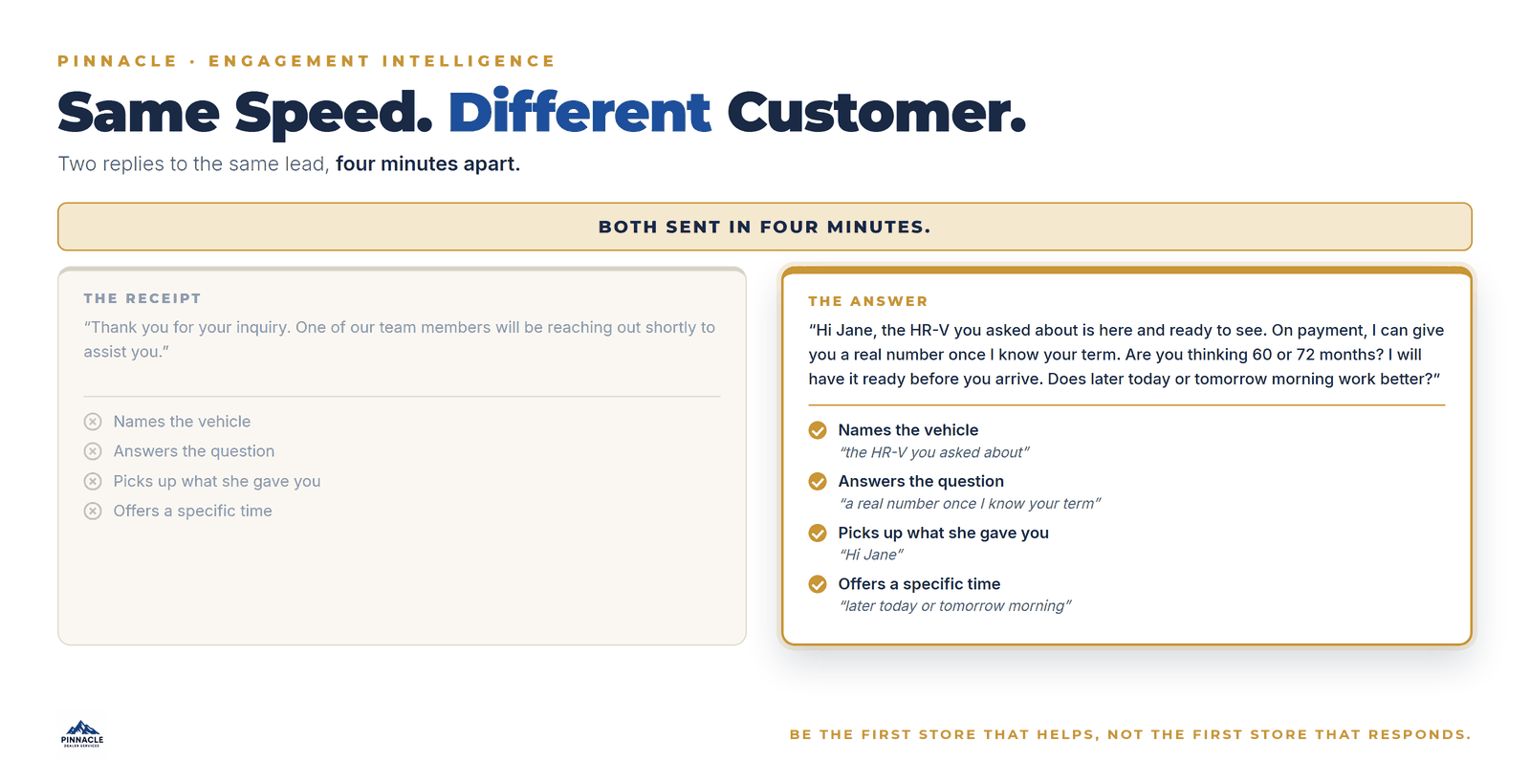
Unsold internet leads respond to relevance — specifically, to the vehicle or the problem they originally asked about. A generic “are you still in the market” is the weakest message in the dealership.
If your team is building these from scratch, the word tracks library has the structural patterns, and our piece on outbound campaigns that do not feel like spam covers tone.
Who Should Own Database Mining
Not “the BDC” as a whole. A named person, with a scheduled block, and a target expressed in conversations rather than dials.
The reason is queue pressure. An agent who is responsible for both inbound leads and database work will do inbound work every time, because inbound has a stopwatch on it and a manager watching the response time. Database work will always lose that fight. Stores that succeed here either assign a dedicated person or protect a fixed daily window during which the inbound queue belongs to somebody else.
If you do not have the headcount to protect that block — which is the honest situation in a lot of stores — this is exactly the kind of work an outsourced phone room absorbs well, because it is campaign-shaped rather than reactive. That is what BDC On Demand is built for.
What to Measure
Dials are not a metric. They are an activity, and reporting them tells you how busy someone was, not whether the campaign worked.
Measure four things per list: contact rate, appointment rate from contacts, show rate, and units. Keeping them separate per list is the whole point — it tells you which list deserves next month's hours. Almost every store that starts measuring this way finds one list quietly carrying the program and another one absorbing time for nothing.
Then compare cost per sold unit from the database against cost per sold unit from purchased leads. That comparison is usually the argument that gets database mining a permanent place on the schedule, and it is the sort of number the BDC resource library exists to help you build.
Frequently Asked Questions
What is database mining at a car dealership?
Database mining is the practice of working a dealership's existing CRM and DMS records to find customers who are ready to transact now, instead of relying only on newly purchased leads. It typically covers customers in positive equity, owners visiting the service drive, upcoming lease maturities, unsold showroom traffic and unsold internet leads. Because the records already exist and the store already has a relationship with those customers, it is generally the lowest-cost source of traffic a dealership has.
How often should a dealership run a database campaign?
Continuously rather than as a periodic push. Equity positions, service visits and lease maturities all change week to week, so a list built once and worked for a month goes stale. The most reliable pattern is a protected daily block owned by a named person, with the underlying lists refreshed weekly, rather than an occasional all-hands campaign that competes with the inbound queue.
Which database list produces the most sales?
It varies by store, which is why the lists should be measured separately rather than blended. Positive equity and lease maturity lists usually convert at the highest rate because the customer has a concrete financial reason to act. Unsold internet leads are the largest list and the lowest converting, but the volume can still make them worthwhile when they are segmented by how far the original conversation progressed.
Do TCPA rules apply to calling my own customers?
Yes. Having an existing relationship with a customer changes some obligations but does not remove them: revocation requests must still be honored across every list you hold, internal do-not-call requests must be recorded and honored, and calling-time restrictions still apply to solicitation calls. Treat your own database as regulated outreach, scrub it against your internal do-not-call list before every campaign, and confirm your own state's rules, which are stricter than the federal baseline in several states.
Do you need a special tool to mine a dealership database?
An equity mining tool makes the positive-equity list far easier to build and keep current, but it is not required to start. Lease maturity, service-drive owners, unsold showroom traffic and unsold internet leads can all be pulled from a standard CRM and DMS with saved searches. The more common obstacle is not the tooling but the absence of a named owner and protected time.
Summary
The best prospects a dealership will speak to this month are already in its own systems. Build the five lists, clean them properly before anyone dials, write outreach that fits each one, give the work an owner and a protected block, and measure by list rather than in aggregate. If the headcount is not there to protect the block, that is the case for outsourcing the phone room rather than the case for skipping the work.