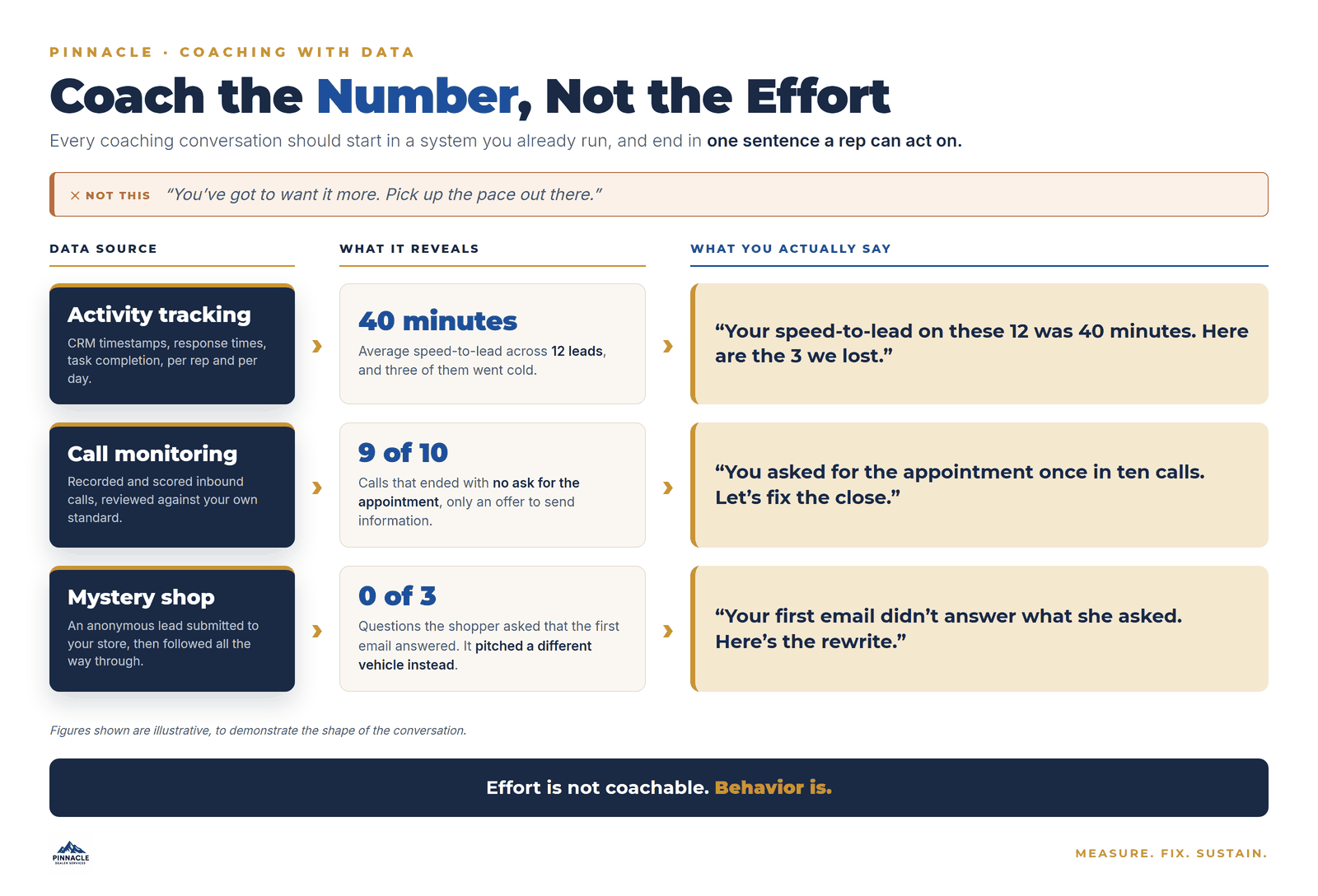
Telling a salesperson to try harder is a grade, not coaching. The evidence you need is already in your activity tracking, your call recordings, and your mystery shops. Real coaching is one sentence: the number, the sample you pulled it from, the specific misses, one change, and a check-back date.
Every manager already owns the evidence they need to coach well. This post shows you how to turn what is sitting in your CRM, your call recordings, and your mystery shops into a single sentence a salesperson can act on tomorrow morning.
“Try Harder” Is a Grade, Not Coaching
“Try harder.” “Set appointments faster.” “You need to be more persistent.”
Every one of those is a grade. None of them is instruction.
They tell a salesperson that something is wrong, which is the easy half. What they never do is say what happened, where it happened, or what to do differently on the next call. So your person walks away knowing they disappointed you and guessing at the fix.
Guessing is not a coaching plan. The manager who moves a store shows up with a number, a sample, and one change.
Your Newest Sellers Are the Ones Not Hearing Back
Salesforce surveyed 4,050 sales professionals across 22 countries for the seventh edition of its State of Sales report. Two findings from that research sit at the center of this post. Among Gen Z sellers, 46% say they rarely get feedback on their sales conversations, and when asked what gets in the way, they name a lack of manager time first. Across the wider survey, 75% of reps say they are more likely to hit their targets when they have a coach or a mentor.
Read those with your own floor in mind. Nearly half of the newest people in your store are having the most important conversation in the business, and nobody is telling them how it went. Then we are surprised when the same mistake shows up in month four that showed up in week two.
That is not a motivation problem on the floor. It is a vacuum above it, which is the practical version of the argument that the manager is the multiplier.
The Leak Is Already in Your Data
The Foureyes 2026 Automotive Dealer Benchmarks Report analyzed 1.4 billion website visits across more than 22,900 dealership websites. It found that 42.7% of qualified leads were mishandled, and that 15.2% of those qualified leads were never logged to the CRM at all.
The number worth sitting with is this one: 62.8% of sales leads did not hear back from a salesperson within 24 hours of returning to the dealership’s website. That is a customer who came back. A second visit, on purpose, to look at your inventory again. Most of the time, nobody called.
Now, a caution about how you use numbers like these. Industry benchmarks tell you, the manager, that the problem is real and widespread enough to go looking for. They cannot tell one of your salespeople what they personally did wrong on Tuesday. No one has ever changed their behavior because of a national average.
That is the whole reason you need your own sample. The benchmark sends you looking. Your store’s data is what you actually put on the desk.
If you have not mapped your process yet, start there instead. You cannot coach the number until you know which step of the sale is leaking, and that is exactly what Map It Before You Coach It walks you through.
Three Sources, Three Different Jobs
Coaching evidence comes from three places, and each one answers a question the other two cannot.
Activity tracking tells you what happened and when. When the lead arrived, when the first attempt went out, how many attempts followed, whether it was ever logged and worked in the CRM, and how it ended. This is your timeline.
Call monitoring tells you what was actually said. Whether the customer reached a person or a hold queue, whether anybody identified what they needed, whether an appointment was requested, and whether the call ended with a next step or with a promise to send information. This is your transcript, and it is the reason grading call quality tells you more than counting answered calls.
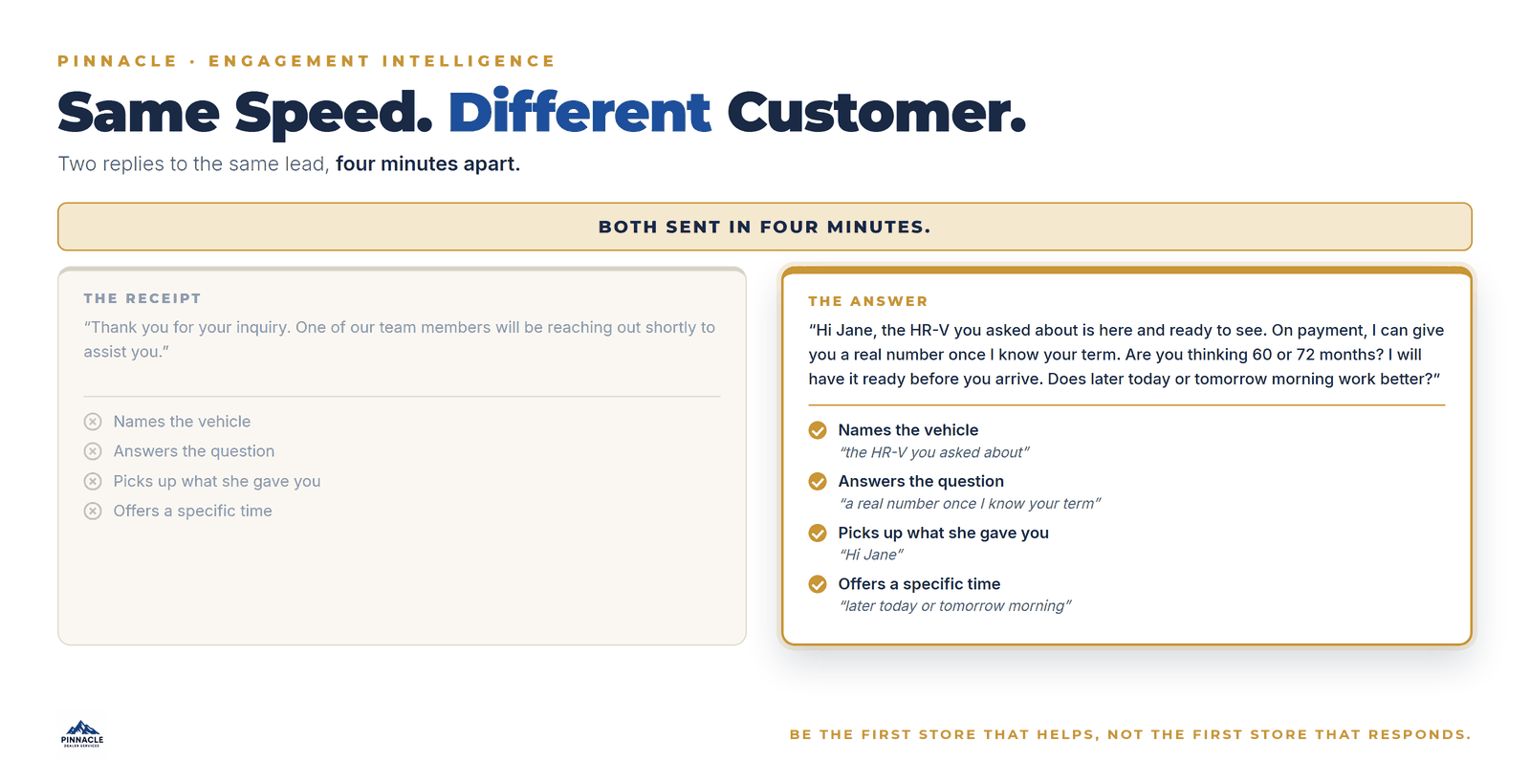
Mystery shopping tells you what your reports cannot see. Your CRM will happily report that a lead was worked. It will not tell you whether the first reply answered the question the customer actually asked, or pitched a different vehicle instead. It will not tell you the tone of that reply. It will not tell you whether anyone tried a second channel when the email went unanswered, or how long the wait felt from the customer’s side of it.
Every store believes its lead handling is better than it is. A secret shop of your own phones, texts and forms is what closes the distance between the belief and the transcript.
At Pinnacle we run Engagement Intelligence shops that follow a real customer inquiry end to end, and comparative head-to-head shops that send the same inquiry to your store and a competitor on the same day. Managers are rarely surprised by the competitor’s score. They are almost always surprised by their own.
The 5-Point Coaching Formula
Every coaching conversation you have should contain five things, in this order.
- The number. One metric, stated plainly. “Your average first response was 40 minutes.”
- The sample. What you reviewed and when. A number without a sample is an accusation. A number with one is evidence.
- The specific misses. Not the whole sample, the individual cases where it broke. Names, or lead numbers, or timestamps.
- One change. Exactly one behavior, described concretely enough to do. Not “be faster,” but “first outbound call inside ten minutes.”
- The check-back. When you are looking again, and at what. Coaching without a check-back is a suggestion.
That is the formula. It fits on an index card, and it works on the phone, in the service drive, and in a 1:1.
The Same Conversation, Twice
Here is what it sounds like when a manager skips the formula:
“Your follow-up needs work. You’re leaving deals on the table. You need to be more persistent.”
And here is the same problem, same manager, same Tuesday, run through the formula:
“I reviewed the 12 internet leads you took Monday through Wednesday. Your average first response was 40 minutes. Three of those customers never answered again after that, and we lost them. For your next 10 leads, I want the first outbound call inside 10 minutes. I’m reviewing those 10 on Friday afternoon and we’ll compare.”
Same problem. Same manager. The first version produces anxiety. The second produces a behavior.
Notice what the second one does not do. It does not question anyone’s work ethic, it does not bring up last month, and it does not ask for five changes. It puts a number on the desk, shows where the number came from, names what it cost, and asks for one thing.
One Behavior at a Time
The formula only works if the person you are coaching can hold what you gave them. Three changes at once is the same as no changes, because nobody knows which one to protect when the floor gets busy.
So pick one. Coach it, check it on the date you promised, and only then move to the next one. That check-back is the part most managers drop, and it is the part that turns a conversation into accountability.
Doing that once is coaching. Doing it every week is a system, and that is where a store actually changes. We will get into how the best GMs run that weekly rhythm later in this series.
Bootcamp
Ready to grow into the leader your store needs? Pinnacle Boot Camp is a 3-day live program plus 90 days of coaching and reinforcement, where managers learn to map their process, coach with data, and develop their next leader. It’s how you build the skills that move a store, and your career. Learn more and apply at PDSDealer.com/BootCamp, and seats are open now at PDSDealer.com/bootcamp-register, or Get In Touch with our team directly.
Summary
Effort is not coachable. Behavior is. Bring the number, the sample it came from, the specific misses you found, one change, and the date you are checking back. Then run it again next week.