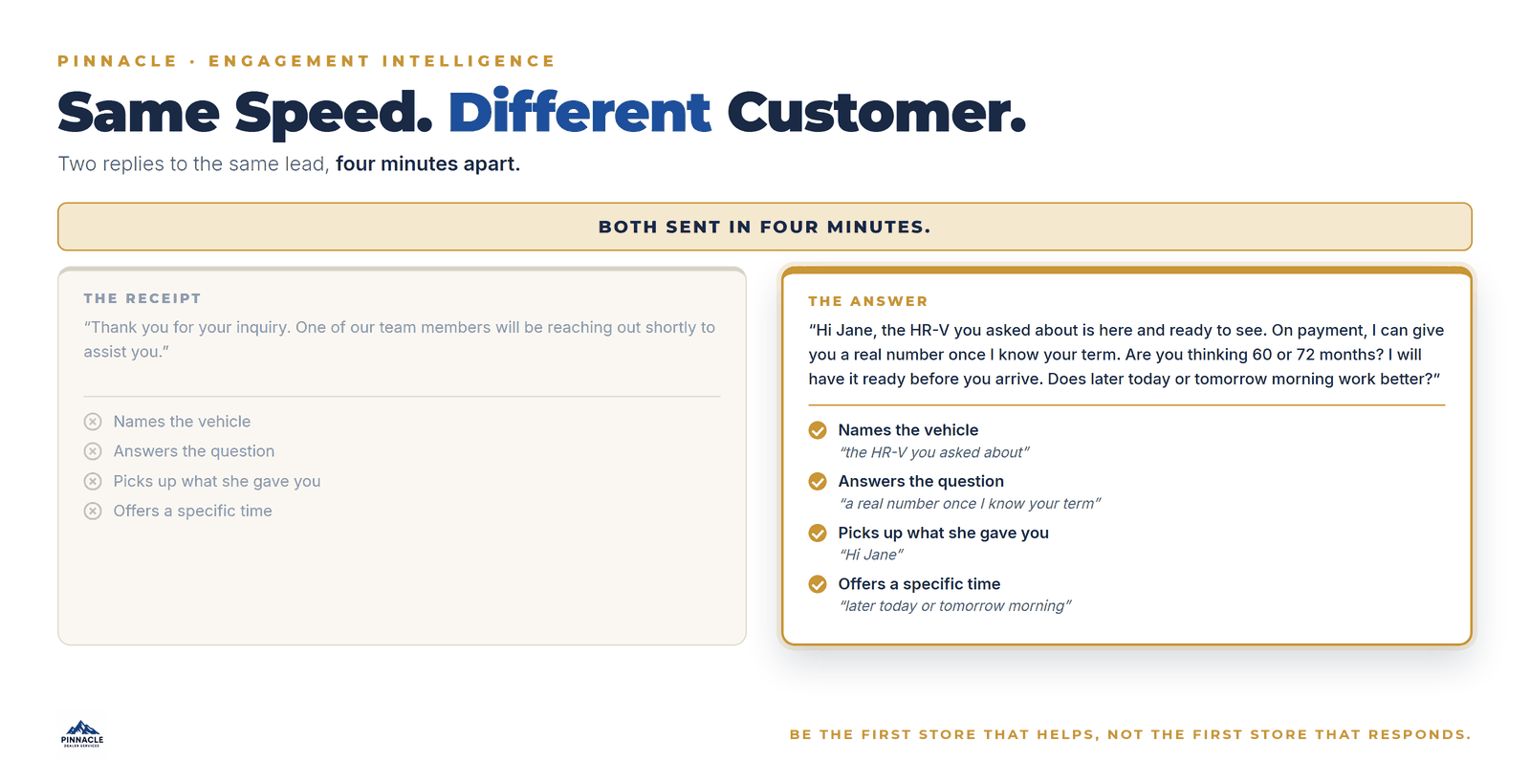

A trade submitted with a lead is the strongest buying signal in it, yet in Pinnacle’s competitive mystery shops only about three in ten first written replies mention it. The miss usually starts in the form routing or the template, not with the salesperson. One sentence acknowledging the trade and starting the appraisal fixes most of it.
Your customer told you what they are driving. Then your first reply acted like they never mentioned it. Here is what that costs, and how to fix it before Friday.
She Told You What She’s Driving. Twice.
Think about what a trade submission actually is.
A customer found a vehicle on your site, decided it was worth a conversation, and then went and did extra homework for you. Year, make, model, sometimes mileage and a payoff. Nobody fills that out casually.
That is a buyer telling you how the deal has to work.
Then the first reply lands: thanks for your interest, I would love to help, when can you come in? Not a word about the trade.
The Trade Is the Part That Makes the Payment Work
This matters more right now than it did three years ago.
Dealers know why. In Cox Automotive’s Q3 2026 Dealer Sentiment Index, the economy was the top factor holding business back, named by 54% of dealers, with interest rates close behind at 34%.
Your customer feels that from the other side. When money is tight and rates are high, the trade is usually the lever that makes the payment land where they need it. It is not a side note to handle at the desk later. For a lot of buyers, it is the deal.
So when your reply skips it, you are skipping the part they care most about.
What We See When We Shop Two Stores
We shop a store and a competitor with the same vehicle, the same question, and the same trade, then compare what the customer got.
Only about three in ten first written responses pick up the trade at all. Seven in ten ignore it.
More than half miss both the trade and the customer’s actual question in the same reply.
And this is not only a dealership problem, it is a lead problem. Foureyes’ 2026 Automotive Dealer Benchmarks Report found that “42.7% of qualified leads were mishandled.” Information gets separated from the customer somewhere between the form and the follow-up, which is the same pattern we walked through in Before You Blame the BDC, Follow the Lead.
The Miss Usually Starts Before Your Salesperson
Here is the part managers get wrong. The instinct is to tell the team to slow down and read the whole lead.
That rarely fixes it, because the trade usually gets lost before anyone types a word.
- The trade comes in through a different form, so it arrives as its own notification or lands lower in the record.
- The first response template has a line for the vehicle and no line for the trade.
- The lead process measures how fast you replied, not whether the reply used what the customer gave you.
- Nobody is clearly on the hook: the BDC assumes the salesperson will handle the appraisal, the salesperson assumes the BDC already did.
None of that is a motivation problem. All of it is fixable.
What a Good First Reply Does With a Trade
Three moves, and they fit in about four sentences.
- Say you saw it. One line. “I also pulled up the Equinox you sent over.” That alone separates you from most of the inbox.
- Move the appraisal forward. Ask for the one thing you need next: mileage, condition, or whether there is a payoff.
- Tie it to the visit. The trade becomes the reason to come in, not a loose end.
Put together, it sounds like a person:
“Hi Jane, thanks for reaching out about the Telluride. I also saw the 2021 Equinox you sent over as a trade, and I can get the appraisal started. About how many miles are on it, and is there a payoff? I can have someone ready to look at it when you come in. Would later today or tomorrow morning work better?”
Same length as the reply you are sending now. Completely different message: somebody read this.
Then Fix It Where It Actually Broke
Once you can see the miss, the question is where to fix it.
If your template never prompts for the trade, that is a template problem, and it gets rewritten. If the trade lands in a different system than the lead, that is a process problem, and it gets mapped and assigned. If the process is solid and the conversation still falls apart, that is a skill gap, and it gets trained.
That is the work we do after a shop. A coach on your floor every month, reading the actual responses your customers received, rebuilding what is quietly costing you the answer, and holding the standard in place until it sticks. You can see how that engagement runs on our capabilities page, and when the gap is skill rather than process, that is what Boot Camp is for.
The shop shows you what your customers are getting. The coaching is what changes it.
The Part You Cannot Audit Yourself
You can read your own templates today. What you cannot see is what the store down the street did with the same customer and the same trade on the same afternoon.
That is the comparison, and it is usually the thing that moves a manager to act. If you want to see what one looks like first, here is a sample head-to-head report.
See whether your first response picks up the trade, and whether your competitor’s does.
Want to see what your customers actually get, and how it compares to a competitor? We’ll mystery shop your store and a competitor of your choice the way a real buyer would, across web, email, text, and phone, then walk you through both side by side in a 30-minute consultation. It’s complimentary. Request your shop at PDSDealer.com/mystery-shop.