
Most dealerships now reply to internet leads within minutes, so speed no longer sets a store apart. In Pinnacle’s competitive mystery shops, only about one in four first written replies answers the customer’s question. A strong first response names the vehicle, answers the question, uses what the customer supplied, and offers a specific time.
Your store probably responds to leads quickly. This post is about what happens next: whether that quick reply actually answered the customer, and how to check yours this week without buying anything.
Speed Was the Old Problem
For a decade the fix was urgency. Respond faster, beat the other store, win the lead.
It worked. Most stores are fast now, and a timestamp has stopped being a differentiator. That reply is still the first thing a buyer sees of your store.
A timestamp tells you a reply went out. It cannot tell you whether the customer got a reason to keep talking to you.
The Funnel Shows Where It Actually Breaks
Look at where deals fall out. Foureyes’ Q1 2026 metro data, drawn from 2.6 million leads across more than 1,150 dealerships, shows a 69% contact rate, a 40% appointment-set rate, a 59% show rate, and an 18.5% close rate.
Stores are reaching people. The 29-point drop from contact to appointment is where the money goes.
Contact is a timestamp. The appointment is what the conversation earned.
What We Find When We Shop Two Stores
When we shop a store and its competitor with the same vehicle and the same question, the pattern repeats almost every time.
- Only about one in four first written responses answers the customer’s question.
- About three in four do ask for the appointment. The ask is there. The reason to say yes is not.
- On the phone, nine in ten stores answer that same question without any trouble.
- So in roughly two-thirds of shops, the store answers on the phone and never puts it in writing.
That last one is the finding managers react to. The answer exists inside your store. Your people know it. It simply never reaches the one message the customer is comparing against two other dealerships.
Customers Don’t Want Receipts
Here is what a receipt looks like in practice. The customer asks what a payment would be. The reply confirms the inquiry was received and says someone will follow up shortly.
She already knows she submitted an inquiry. What she wanted to know is whether anyone read it.
The other version of the same miss is the deferral: “a specialist will reach out with those details.” In a Pinnacle shop, fully answering the customer’s question is one of the most heavily weighted items on the scorecard, and a deferral earns zero. Not because it is rude, but because the customer is no closer to an answer than before they wrote.
Sometimes you genuinely cannot answer yet. Fine. Move the question forward anyway, and say exactly what you need to finish it.
What a Strong First Response Does
Four things, in about five sentences.
- It names what they asked about. The vehicle, the trim, the stock number. Proof a person read the lead.
- It answers the question as directly as it can. If the answer is available, give it. If it needs one more input, ask for that input.
- It picks up what the customer already handed you. A trade, a timeline, a down payment, a question about fees. Never make them type it twice.
- It offers a specific next step. Two times beat “let me know when works.”
Here is the difference on the same lead. A customer asks whether a 2027 HR-V is available and what her payment would be.
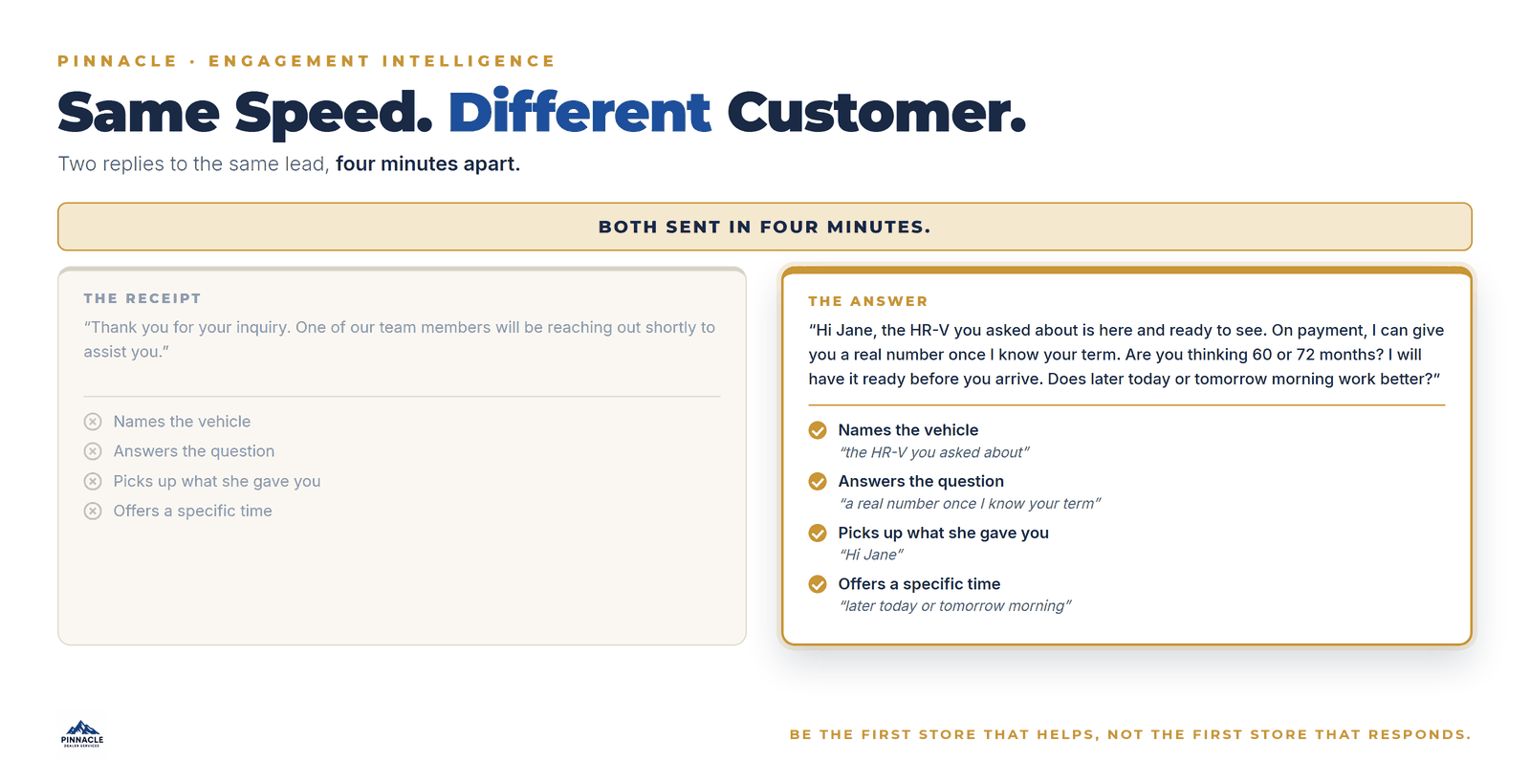
Receipt version: “Thank you for your inquiry. One of our team members will be reaching out shortly to assist you.”
Answered version: “Hi Jane, the HR-V you asked about is here and ready to see. On payment, I can give you a real number once I know your term. Are you thinking 60 or 72 months? I will have it ready before you arrive. Does later today or tomorrow morning work better?”
Same speed. Completely different customer.
The price and payment side of this has its own rules, and its own trap, which is the subject of The Price You Advertise Is the Question They’ll Ask.
Audit the Answer, Not the Timestamp
Try this with your own leads this week.
Pull several recent internet leads. Hide the activity log first, so you see only the customer’s message and what your store sent back. Read them the way the customer did.
Then bring the log back up and compare. The log says contacted in four minutes. Does the message look like four minutes of work, or like a button?
Where those two disagree, you have found your coaching opportunity. Bring the actual message to the one-on-one, not a feeling about follow-up, which is how we coach it in Coach the Number, Not the Effort.
Fix the Template, Then Coach the Habit
Most of what we find here is not a people problem, and it does not get fixed by asking the team to try harder.
It gets fixed in two moves. First the template: the store sets a standard for what every first response must contain, and rebuilds the canned replies that are quietly stripping the answer out. Then the habit: a coach on your floor every month, working the actual messages with your team, running the role-play, and tracking the change until it holds.
That is what happens after a shop with us. The report shows what your customers received. The coaching is what makes next month’s messages different. When it is a skill gap rather than a process gap, that is what Boot Camp is for.
The goal is not to be the first store that responds. It is to be the first store that helps.
Find out whether your team answers the question, or just answers fast.
Want to see what your customers actually get, and how it compares to a competitor? We’ll mystery shop your store and a competitor of your choice the way a real buyer would, across web, email, text, and phone, then walk you through both side by side in a 30-minute consultation. It’s complimentary. Request your shop at PDSDealer.com/mystery-shop.