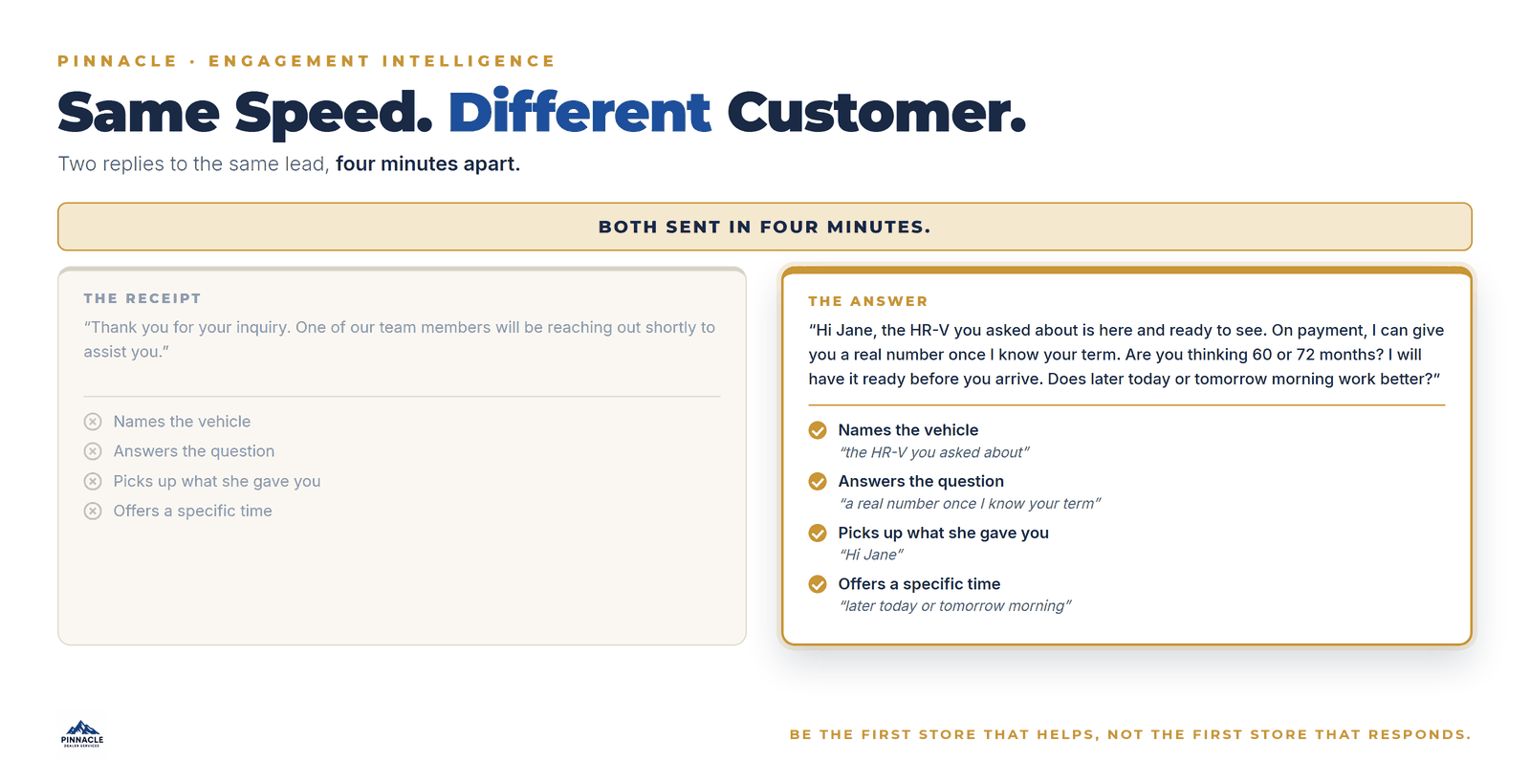

Dealer price transparency starts in the first reply. On March 13, 2026, the FTC warned 97 auto dealership groups that advertised prices must be the total price, including all mandatory fees. When a customer asks about a price, say what the number covers, ask for the one detail you need, and name anything still to be confirmed.
Dealer price transparency does not start at the desk. It starts in the first reply, about four minutes after somebody asks what your advertised price actually means.
Your Price Started the Conversation
A customer finds a vehicle on your site. There is a number on the page. They decide it is close enough to be worth asking about, and they send you a question about it.
Then the reply comes back: “Pricing depends on several factors. A salesperson will reach out with more information.”
Read that the way she does. She just told you she saw a price. You just told her the price depends.
Nobody meant it that way. But the message she gets is that the number on your website was the beginning of a negotiation she has not agreed to yet.
What the FTC Said in March
This moved from a marketing question to a compliance one this year.
On March 13, 2026, the Federal Trade Commission warned 97 auto dealership groups about deceptive pricing. The requirement it stated is short: advertised prices “must be the total price, including all mandatory fees, that consumers will be required to pay.”
Confirm how that applies to your store, your state, and your current ads with your compliance advisor. That part is not our lane.
The floor-level version is simpler. If you advertise a number, your first reply has to be ready for the question that number creates.
The Reply That Undoes Your Own Ad
Here is what we find when we shop stores on a price question.
The customer asks something specific: is this price negotiable, what rebates apply, what would the payment look like. The reply is fast, friendly, and answers none of it.
In our competitive shops, only about one in four first written responses answers the customer’s question at all. On the phone, nine in ten stores answer that same question without breaking a sweat.
So in roughly two-thirds of shops, the store has the answer, says it out loud on a call, and never puts it in writing.
One head-to-head shop shows what that costs. The customer asked about rebates. On the call, the salesperson gave real numbers and handled it well. The store’s only written reply to that same question said: “What questions can I answer for you?”
The competitor’s salesperson texted the exact rebate seven minutes after his call ended. That was the only written answer the customer received, and it came from the other store.
Which one would you have believed?
Being Clear Is Not the Same as Guessing
“Answer the price question” does not mean invent a payment. Nobody should be quoting approvals, rates, or trade values they have not confirmed.
It means three things:
- If the advertised price is the number, say so plainly.
- If part of the answer needs information you do not have, ask for that one thing.
- If something has to be confirmed, name it, so the customer knows what is pending instead of guessing at your motives.
Compare the two:
Weak: “Thanks for your interest in the Silverado. Pricing and payments depend on several factors. When would you like to come in?”
Strong: “Hi Marcus, the Silverado is listed at $41,980, and that is the price before tax and tags. On payment, I can give you a real number once I know your term. Are you thinking 60 or 72 months? I can have options ready before you get here. Does tomorrow morning work?”
The second one does not promise anything the salesperson does not know. It just proves somebody read the question.
Audit It This Week
This one takes twenty minutes and you can do it yourself.
Pull your recent leads that included a price or payment question. Ignore the CRM notes on the first pass. Read the customer’s question, then read what your store sent back, and ask:
- Did we acknowledge the specific price or offer the customer mentioned?
- Did we answer the part we could answer?
- If we needed more information, did we ask for it?
- Did we give them a real next step?
- Could the customer understand the answer without calling us?
- Does the language match how we advertise today?
Then pull the call recording on the same lead and compare. If your salesperson answered it beautifully on the phone and the written reply dodged it, you have found your gap, and it is not a people problem.
Most price answers break upstream, in the template or the routing, which is the same thing we traced in Before You Blame the BDC, Follow the Lead.
Where the Fix Actually Lives
Once you can see it, the fix sorts itself into three buckets.
Template, when the canned reply has no room for a real price answer. Process, when pricing questions route to somebody who cannot answer them. Skill, when the salesperson has the information and still cannot walk a customer through it cleanly.
After a shop, that is the work: a coach on your floor every month reading real responses with your team, rebuilding the templates that are costing you the answer, and keeping the standard from drifting once attention moves on. You can see how that runs on our capabilities page. When it is a skill gap, Boot Camp is where we fix it.
Your ad and your first reply should tell the same story. Right now, for most stores, they do not.
If you want to see what the comparison looks like before you ask for one, here is a sample head-to-head report.
See how your price and payment answers stack up against the store down the street.
Want to see what your customers actually get, and how it compares to a competitor? We’ll mystery shop your store and a competitor of your choice the way a real buyer would, across web, email, text, and phone, then walk you through both side by side in a 30-minute consultation. It’s complimentary. Request your shop at PDSDealer.com/mystery-shop.