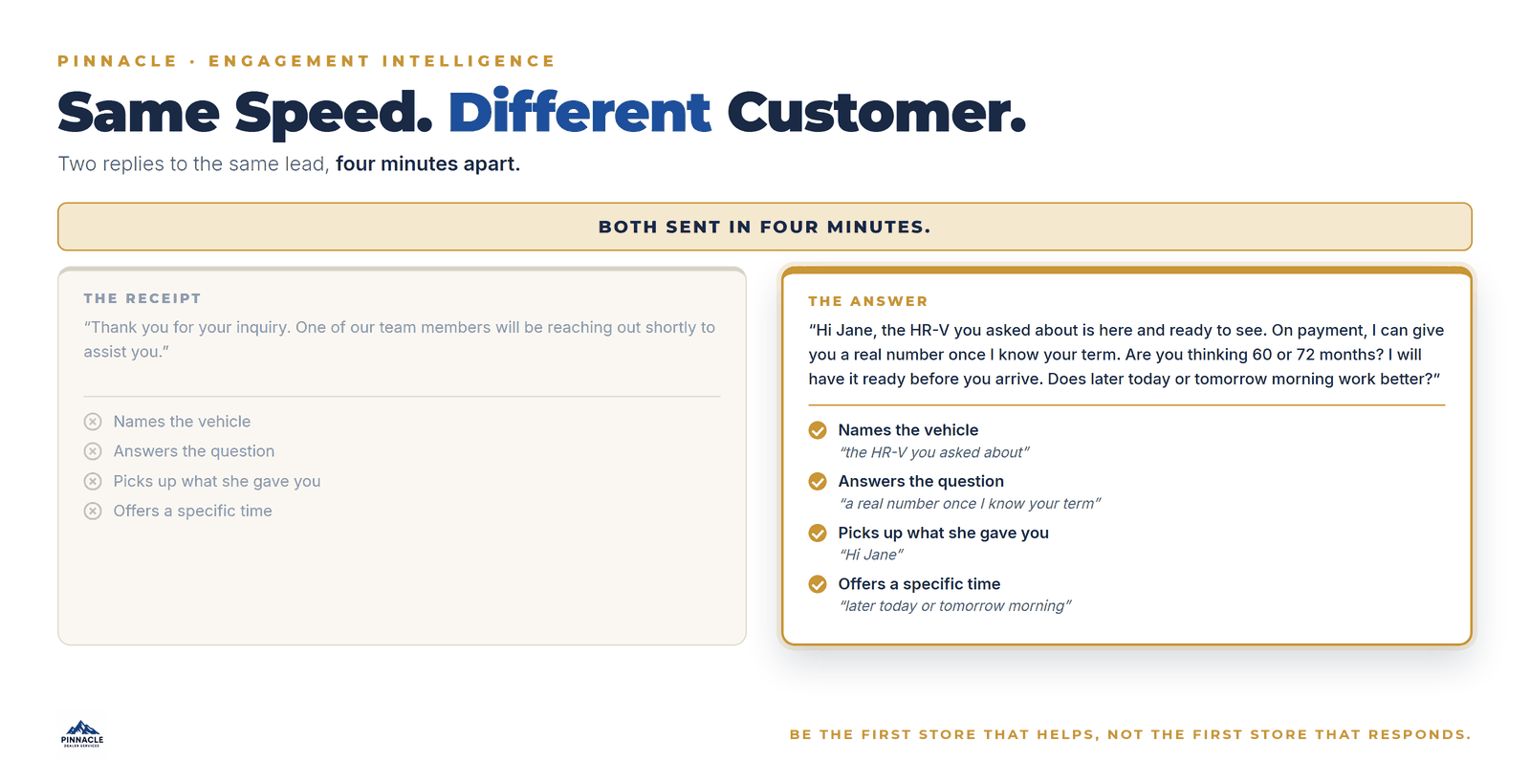

Customers rarely state their real need in a straight line. Repeating the details back gives the rep a chance to organize what was said and the customer a chance to correct it. Follow the recap with clarifying questions to surface the budget, trade, or concern sitting behind the surface question.
Customers Aren’t Straightforward
When a customer calls, reps cannot pick up the phone assuming the customer will be straightforward.
A customer calls about an oil change, and instead of getting right to the point, they start talking about a warning light, tire concern, or upcoming road trip. A sales caller asks about the availability of an SUV they were looking at a week ago, but they’re actually trying to figure out their budget, what fits their family, or a trade situation.
Answering The Surface Question And Nothing More
Reps answer the surface question a customer is asking, but miss the underlying details of the question.
A customer asks about a specific vehicle, and the rep immediately confirms the vehicle’s availability without confirming whether the customer actually liked it, whether they want to buy it, if they have a trade, or what else they’re comparing.
A customer describes a noise, a warning light, a strange smell, and mentions a scheduling concern all in one sentence. The rep immediately moves into scheduling an appointment instead of taking the time to slow down and repeat back what the customer said. This is one of the most common reasons service calls fail.
When emotions are running high, moving too fast is even more detrimental. If a frustrated customer is talking about their car not starting and the service rep jumps right into policy, it will make the customer feel unheard, which will cause them to become even more stressed out and frustrated.
Standards Are Strict
In PwC’s 2025 Customer Experience Survey, 52% of surveyed consumers said that they stopped using or buying from a brand because they had a bad experience with the product or services, while 29% of surveyed consumers say that they stopped due to a poor customer experience online or in-person. The statistics demonstrate that customers are strict with the brands that they support or buy from, and even one bad experience can turn them off from a brand. In your dealership, this means that reps must take extra care to leave a good impression on the customer, which means getting and remembering all of their details and concerns to adequately help them.
Listen First / Repeat Details Back
Dealerships must employ the practice of listening first and repeating details back. Reps first must acknowledge the customer and clarify they understood them by saying something like, “I understand. Let me make sure I’m following….” This gives the rep a chance to organize the details, and the customer a chance to clarify or correct the rep on missed or inaccurate details.
Once the rep has organized all of the details, they must ask the customer clarifying questions. If a sales customer says they want to buy a specified car, the rep should ask if they have a particular budget, if they want to trade something in for the car, and if they want to look at other options first. This helps the rep make sure they are addressing all of the customer’s concerns, even the ones the customer does not outright communicate. The most important part is clearly repeating details back. If a customer says they want to buy a car they had shown interest in on a prior call, the rep must say something like, “The Toyota Prius you looked at last week, right?” Once the customer confirms, then the rep should jump into more clarifying questions. It is the qualifying step at the center of the dealership call framework.
Managers should drill this every call review and reinforce it through ongoing sales consultant training. Frequently mystery shop phone lines, and look out for whether reps jumped between details or took the time to repeat back details and ask clarifying questions.
Bootcamp
Pinnacle Dealer Services is hosting a 3-day bootcamp this September in Lake Mary, Florida, where we offer in-person coaching for your representatives based on frameworks just like the one in this article. We will also follow-up with your dealership after the initial training to keep track of your improvement. Don’t hesitate to sign up on our website: Get Started – Pinnacle Sales and Mail
Summary
Repeating back what the customer said is a trust-building tool. When reps mirror and recap, they reduce confusion, uncover the customer’s real need, and help the customer feel confident moving forward.