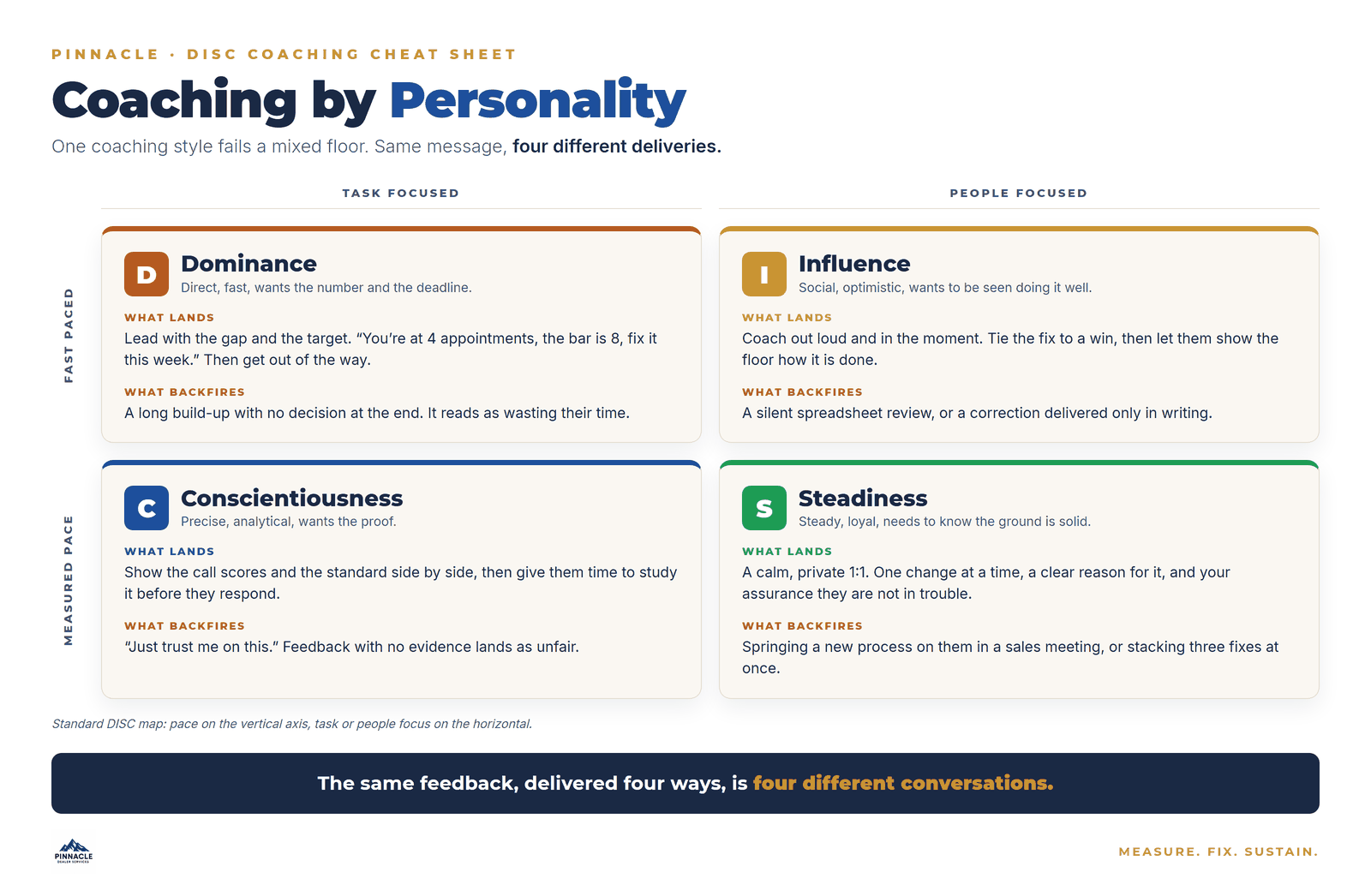
One coaching style fails a mixed sales floor. DISC sorts how people take direction: Dominance, Influence, Steadiness, Conscientiousness. The number does not move and the standard does not move. What changes is how you open, what you emphasize, and how much room you leave the person to think it through.
You can walk onto the floor with the right number, the right sample, and the right fix, and still watch the coaching bounce off. Not because the message was wrong, but because it was delivered in a style the person across from you does not process. This post is about the delivery.
One Message, Four Reactions
A manager walks the floor and tells four salespeople the same thing: “I need you asking for the appointment more directly.”
The first one nods and is on the phone before you finish the sentence. You will not hear about it again unless it does not work.
The second one gets visibly excited, tells you about a customer from yesterday, and wants to try it on the next call with you listening.
The third one goes quiet. She is not resisting. She is wondering what else is about to change, and whether the way she has been doing it was wrong the whole time.
The fourth one asks what “more directly” means. He wants to know the exact wording, and whether it applies to every customer or only qualified ones.
One instruction. Four reactions. Nobody was being difficult, and the message never changed. That is the problem with one-size-fits-all coaching, and DISC is the shortest way to see it coming.
What DISC Is, and What It Is Not
DISC sorts behavior into four tendencies:
- D (Dominance): direct, fast-paced, results-focused.
- I (Influence): expressive, social, enthusiastic.
- S (Steadiness): patient, supportive, consistency-focused.
- C (Conscientiousness): analytical, precise, detail-focused.
Two honest caveats before we go further, because this tool gets misused constantly.
DISC describes style, not ability. There is no selling style. High-D does not mean high performer, and high-S does not mean soft. All four close cars. DISC only describes how they close them.
DISC is a description, not an excuse. The moment a manager says “well, he’s a high-D, that’s just how he is,” the tool has stopped being a coaching aid and become a reason to avoid the conversation. The number is still the number. The standard does not move. What changes is how you say it.
Hold onto that last line, because it is the frame for everything below. Same number, same evidence, four different conversations.
Coaching the Four Styles
D: get to it
What you see: no patience for setup. They want the gap, the target, and the deadline.
What breaks it: a long build-up that ends without a decision. Fifteen minutes explaining why appointments matter reads to a D as fifteen minutes you wasted.
How you open:
“Five of your last eight qualified calls ended with no appointment ask. Next ten calls, offer two specific times. I’m checking Friday.”
That is the entire conversation. Say it, confirm they have it, and get out of the way. The brevity is not you being blunt, it is you being respectful of how they take direction.
I: coach it out loud
What you see: they process by talking. They will get further in five minutes of back and forth than in an hour of reading.
What breaks it: a silent spreadsheet review, or a correction that arrives only in writing. Written criticism with no conversation around it lands ten times heavier than you meant it.
How you open: pull up a call and listen to it together. “Right here, where she asks about the payment. What would you say next if we could run it again?” Let them find it, then have them try it on the next live call while you are standing there. Recognition is fuel for an I, so when the new behavior shows up, say so where other people can hear it.
S: fence off what is not changing
What you see: steady, reliable, and quietly anxious about sudden change. They want to know the ground is solid.
What breaks it: springing a new process on them in a sales meeting, or stacking three fixes at once. An S will absorb all three, protect none of them, and conclude they are failing.
How you open: privately, calmly, and by naming what stays the same first.
“Your greeting stays the same. Your qualification stays the same. There’s one thing we’re changing this week: once the customer is qualified, we’re going to offer two firm appointment times instead of leaving the next step open.”
Then tell them plainly that they are not in trouble. They are wondering.
C: show the work, then stop talking
What you see: they want the standard and the evidence before they will commit to a change. Questions are not resistance, they are how a C buys in.
What breaks it: “just trust me on this.” Feedback with no evidence behind it reads to a C as unfair, and once they have decided the process is unfair, you have lost more than one call.
How you open: put the whole picture in front of them at once.
“I reviewed your last 15 conversations. You reached qualification on nine. You proposed a specific appointment on three. On the six where you didn’t, the customer left without a next step.”
Then do the part most managers skip: stop talking. Give them the file and a day. A C coached in real time will argue with you because they are still working it out. A C who has had time to check your numbers will come back having already decided you are right, and that change will hold.
One clarification worth making, because it gets misread: this does not mean you cannot practice with a C. It means you define the standard first and let them see the evidence, and then they will roleplay against it all afternoon.
The Mistake: Coaching in Your Own Personality
Most managers do not coach four ways. They coach one way, their own, and it happens to work on whoever shares their style.
The direct manager assumes everyone appreciates blunt feedback. The analytical manager buries the whole floor in data. Neither is being a bad manager. They are being consistent, and consistency is the wrong instinct here.
You are the one with four people reporting to you. They each have one style. You are the one who adapts, and that is not softness, it is leverage: the same coaching delivered four ways produces four fixes instead of one. This is the same argument we made in The Manager Is the Multiplier, applied one conversation at a time.
It also assumes you already know what you are coaching. Style is the delivery, not the diagnosis, so if you have not yet found the step of the sale that leaks, map the process first and build the coaching sentence before you worry about how to say it.
The Business Case for Coaching This Way
If this sounds like extra work, the research says it is the work.
Deloitte’s 2025 Global Human Capital Trends study, based on nearly 10,000 business and HR leaders across 93 countries, found that 67% of leaders say customizing the design and experience of work around workers’ skills, motivations, passions, work styles, and behaviors is important. On the other side of the desk, 69% of workers said they are comfortable with their organization knowing more about them when it leads to communication tailored to their needs.
Both sides want this. Your people are not asking you to lower the standard. They are asking you to deliver it in a way they can actually use.
Bootcamp
You cannot coach by style until you know the styles. At Pinnacle Boot Camp, every attendee is profiled with DISC and leaves with their own behavioral profile plus a coach-by-style cheat card for every personality on their team. Then you practice it live: DISC for selling, coaching by DISC across your floor, and DISC for hiring, team mix, and conflict.
Ready to grow into the leader your store needs? Pinnacle Boot Camp is a 3-day live program plus 90 days of coaching and reinforcement, where managers learn to map their process, coach with data, and develop their next leader. It’s how you build the skills that move a store, and your career. Learn more and apply at PDSDealer.com/BootCamp, and seats are open now at PDSDealer.com/bootcamp-register, or Get In Touch with our team directly.
Summary
The standard never moves. What moves is how you open, what you emphasize, and how much room you leave the person to think. Same number, same evidence, four different conversations. You flex, and your people don’t have to.